“In the age of Vibe Coding, standardization and simplicity are not a compromise on quality — they are a technical requirement.”
Introduction
Software development is undergoing an epochal transformation. The advent of AI coding agents — from GitHub Copilot to Claude Code, from Cursor to Augment — has introduced a new actor in the software lifecycle: the machine as an active developer, not as a mere passive tool.
This transformation raises an architectural question that many teams are now facing: are traditional software architectures, designed to discipline human teams, still optimal when 50-80% of the code is generated or reviewed by AI agents?
The answer, supported by academic research, documentation from industry leaders like Martin Fowler and Thoughtworks, and official best practices from Anthropic and GitHub, is clear: architectures based on exotic patterns, hyper-abstractions, and non-standard variants of established patterns systematically degrade AI agent output quality. A “standard-first” architectural approach is not a surrender to mediocrity — it is a technical precondition for achieving reliable results in a multi-agent ecosystem.
This article analyzes the problem from three complementary angles: the inner workings of Large Language Models, the physical constraints of the context window, and the operational dynamics of a multi-agent software lifecycle. For each dimension, technical evidence and authoritative references are presented.
1. How LLMs Generate Code: Parametric Memory and Statistical Bias
1.1 The Fundamental Mechanism
Large Language Models generate code through statistical pattern-matching on their training data. This is not an implementation detail — it is the structural characteristic that determines what works and what doesn’t in the interaction between software architecture and AI agents.
LLMs have been trained on billions of lines of open-source code from GitHub, Stack Overflow, official documentation, and public repositories. The architectural patterns that appear most frequently in this corpus — classic MVC, canonical Repository Pattern, standard Clean Architecture, CQRS via MediatR — constitute what is technically defined as the model’s parametric memory: the “native” knowledge that the model carries with it without needing explicit instructions.
When a project’s code follows these standard patterns, the AI agent operates in zero-shot mode: it produces excellent results based solely on its internalized knowledge from training, without needing additional instructions in the context.
1.2 The Cost of Exoticism: In-Context Learning vs. Parametric Memory
When an architecture imposes non-standard patterns — such as strict DDD for write operations combined with direct database reads in controllers, or custom common interfaces for commands and entities — the agent is forced to abandon what it “knows by nature” and rely entirely on explicit instructions provided in the context. This mechanism is called In-Context Learning and presents two documented problems:
Symmetry breaking: LLMs work through sequential probability. If an agent observes that write operations use a Command Handler with strict DDD, the model’s probability distribution will expect a symmetric Query Handler for reads. Breaking this symmetry — by introducing direct reads from the controller — creates a conflict between the model’s prediction and the actual architecture. The result is hallucination: the agent generates standard code, violating the project’s custom rules.
Context saturation: even with a 1 million token context window, custom instructions compete for the model’s attention with source code, conversation history, and all other artifacts in the context. The more exotic the architectural rules, the more tokens are needed to describe them — and the more tokens are subtracted from understanding the actual task.
1.3 Evidence from Research
A 2025 arXiv paper (“LLM Hallucinations in Practical Code Generation”) confirms this behavior: models tend to generate code based on common patterns in the training data rather than on a deep understanding of architectural specifications provided in context. The most empirically frequent violations are:
- Common > Custom: standard Express.js patterns prevail over proprietary conventions
- Simple > Structured: direct database calls preferred over the Repository Pattern when context is ambiguous
- Familiar > Framework-specific: default exports and patterns ubiquitous in training data prevail over project conventions
An additional arXiv study (“Do Code LLMs Understand Design Patterns?”) empirically evaluated the ability of code LLMs to classify and generate code adhering to design patterns. The results show that some models — including GPT-4o — perform better without explicit information about design patterns, because they rely on patterns already internalized during training. Standard patterns are structurally “native” to models; custom patterns require cognitive overhead that degrades output quality.
A team that measured architectural pattern compliance on a real project recorded 30-40% compliance with static documentation (markdown files, wikis, analysis documents), which rose to 80% only by introducing real-time agentic feedback loops on standard patterns.
References:
- Liu et al., “LLM Hallucinations in Practical Code Generation”, arXiv, 2024 — arxiv.org/html/2409.20550v1
- “Do Code LLMs Understand Design Patterns?”, arXiv, 2025 — arxiv.org/html/2501.04835v1
- Vuong Ngo, “AI Keeps Breaking Your Architectural Patterns. Documentation Won’t Fix It.”, dev.to, 2025 — dev.to/vuong_ngo
2. The Context Window: A Physical Constraint, Not a Theoretical One
2.1 The “Lost in the Middle” Phenomenon
The foundational study “Lost in the Middle: How Language Models Use Long Contexts” (Liu et al., Stanford University, UC Berkeley, Samaya AI, 2023) scientifically demonstrated that LLM performance follows a “U” curve in relation to the position of information in the context.
The researchers conducted a controlled experiment: given a set of documents where only one contains the correct answer, they varied the position of that document — beginning, middle, or end of the context. The results show that:
- Accuracy is highest when relevant information is at the beginning of the context (primacy bias)
- Accuracy is high when information is at the end (recency bias)
- Accuracy drops significantly when information is in the middle
This pattern has proven consistent across multiple models, different architectures, and varying sizes. It is not a defect of a single model — it is a structural characteristic of the transformer architecture.
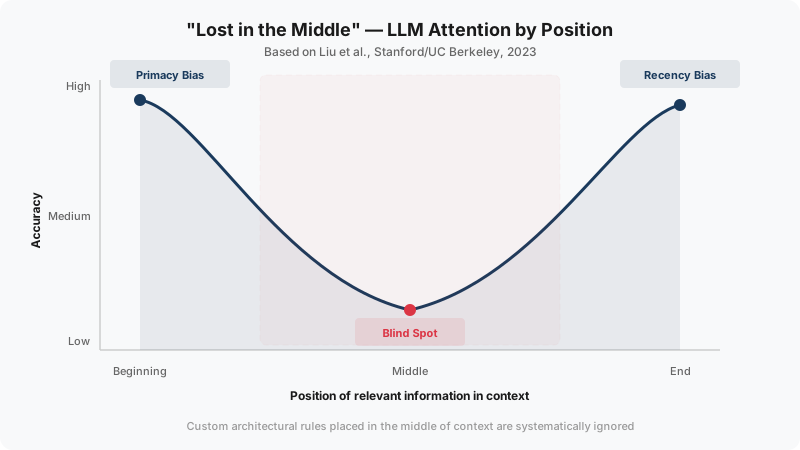
Why this matters for software architecture: If the project’s non-standard architectural rules — such as exceptions to strict DDD, conventions for direct reads from controllers, custom common interfaces — are contained in analysis documents or lengthy CLAUDE.md files, the agent will tend to ignore them when they are “buried” in the middle of a large context. In the absence of clear and prominent instructions, the AI will fall back to its parametric memory, generating standard code.
Fewer custom rules means fewer chances that the AI loses them in the middle of the context.
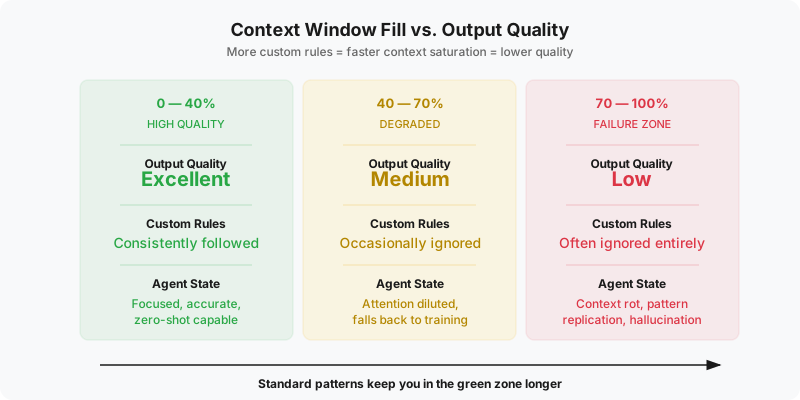
2.2 Progressive Context Window Degradation
Empirical research shows that LLM performance degrades progressively as the context window fills up, even when staying within the model’s declared theoretical limits. The underlying mechanisms are:
- Attention Dilution: the self-attention mechanism in transformers has O(n²) complexity. The more tokens present in the context, the harder it is for the model to focus on information relevant to the current task
- Context Rot: with very large contexts, models begin replicating patterns from conversation history rather than from training data, becoming progressively “less intelligent”
- Option Overload: too many tools, alternative patterns, or available approaches in the context lead to poor choices — a cognitive limitation that affects both AI and humans
- Token Economics: every extra token in the context has a direct economic and computational cost. A 2,000-line architectural specification costs 6x more to process than a 300-line one, proportionally reducing the budget available for task reasoning
Experimental data quantifies the impact:
| Context Window Fill | Output Quality | Custom Instructions Followed |
|---|---|---|
| 0–40% | High | Consistent |
| 40–70% | Medium | Occasionally ignored |
| 70%+ | Low | Often ignored entirely |
The operational objective for a team using AI agents is to maximize the time the agent operates in the “High Quality” zone (below 40% of the context window). A standard architecture that doesn’t require additional documentation for the agent to understand it leaves more room in the context for the actual task.
References:
- Liu et al., “Lost in the Middle: How Language Models Use Long Contexts”, Transactions of the Association for Computational Linguistics, Vol. 12, 2023 — arxiv.org/abs/2307.03172
- “Why Your AI Agent Gets Dumber with Large Specs (And How to Fix It)”, lean-spec.dev, 2025 — lean-spec.dev/blog/ai-agent-performance
- “Context Windows Explained: Why Size Matters for AI Coding”, inventivehq.com, 2026 — inventivehq.com/blog/context-windows-explained-ai-coding
- “Why You Need To Clear Your Coding Agent’s Context Window”, willness.dev, 2026 — willness.dev/blog/one-session-per-task
3. The Physical Segregation Problem: DLLs, NuGet, and Agent Visibility
3.1 How AI Agents Navigate Code
Tools like GitHub Copilot, Claude Code, and LSP agents work by indexing and reading source files in the local workspace. The agent builds its understanding of the project through direct analysis of source code, type definitions, imported dependencies, and directory structure.
When the implementation of a command, entity, or service is “locked” inside a compiled NuGet package, the AI agent sees only the public signature (the interface), but cannot explore its source code to understand:
- The actual implementation behavior
- The underlying business domain
- Any side-effects or invariants not expressed in the interface
- Internal naming and structuring conventions
This makes the agent blind to the bigger picture. The model is forced to infer behavior from the interface — a process prone to hallucination, especially when interfaces are custom and don’t correspond to patterns known from the training data.
3.2 Monorepo vs. Polyrepo in the Vibe Coding Era
The AI-driven development community has already addressed this question systematically. The article “Monorepo vs. Polyrepo for Multi-Stack Vibe Coding: A Developer’s Decision Framework” clearly explains that in AI-first development, monorepos or logically cohesive architectures win decisively:
“In a monorepo, the AI agent sees everything. It can trace a user action from the frontend button click, through the API call, to the database update, and back to the UI state change — all in a single context window.”
The advantage is threefold:
- Complete contextual visibility: the agent can perform cross-boundary reasoning, understanding how components actually interact
- Improved pattern recognition: on a cohesive codebase, the agent recognizes and replicates existing patterns more accurately and consistently
- Atomic modifications: a feature that spans multiple layers can be implemented in a single commit, without manual coordination between repositories
A well-organized monorepo — logically structured but not excessively segregated physically — is infinitely superior for agentic development compared to an architecture fragmented across dozens of closed NuGet packages.
References:
- “Monorepo vs. Polyrepo for Multi-Stack Vibe Coding”, forceweaver.com, 2025 — blog.forceweaver.com/blog/repo-types
- “Monorepo vs Polyrepo: AI’s New Rules for Repo Architecture”, Augment Code, 2025 — augmentcode.com/learn/monorepo-vs-polyrepo
- Gary Sheng, “The Right Way To Work Across Multiple Repos with AI Agents”, LinkedIn, 2026
4. The Multi-Agent Lifecycle: Context Asymmetry and Visibility
4.1 The Problem of Agents with Partial Visibility
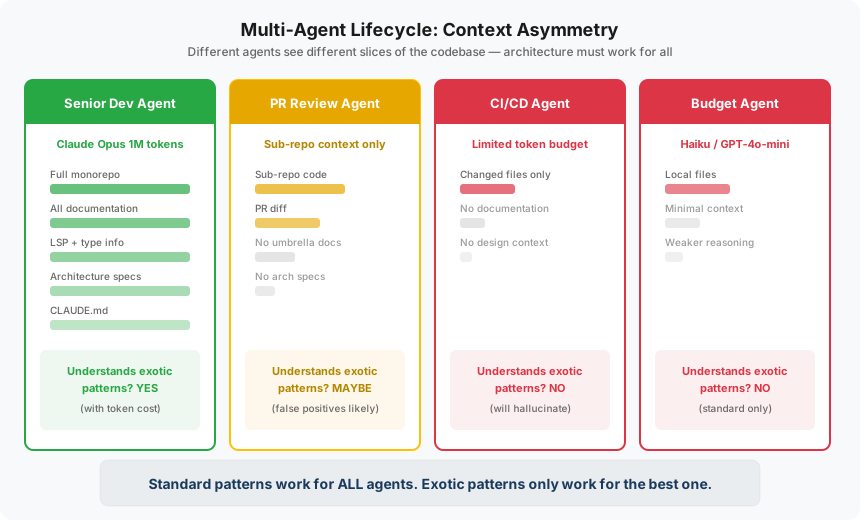
In a modern software project, code is touched by multiple AI agents with radically different contexts, visibility, and capabilities throughout its lifecycle:
- The senior developer’s primary agent (e.g., Claude Code Opus with 1M tokens, full LSP, access to the monorepo and all documentation): knows everything, understands architectural choices, has access to functional analysis documents and guidelines
- The PR review agent on a sub-repo: operates in its own isolated context window, potentially without access to technical documentation contained in the main umbrella repo
- The CI/CD agent: has limited token budget, zero access to design documents, must validate code based on its intrinsic structure
- The end-of-month developer’s agent: uses economic models (Claude Haiku, GPT-4o-mini) to preserve the monthly token budget — operates with limited context and reduced inferential capability
This asymmetry is a structural fact of the software lifecycle in the agentic era, not an edge case.
4.2 Sub-Agent Context Hierarchy
Recent technical literature identifies this as a context hierarchy isolation problem. The recommended solution is a three-level hierarchy:
- Root context (20-50 lines): patterns shared by all agents — naming conventions, error handling, general architecture
- Agent context (100-200 lines): behavioral flows specific to the agent’s role (development, review, CI/CD)
- Package context (50-150 lines): domain-specific patterns for the code the agent manages
The critical point: the root context — which must contain the shared base conventions — only works if those conventions are simple, compact, and standard. A convention that requires 500 lines of explanation to be understood cannot physically fit in the root context without saturating the token budget available for all downstream agents.
4.3 Local Deducibility
The engineering community defines the key property of an AI-friendly codebase as local deducibility: an agent must be able to figure out what to do by looking only at files adjacent to the modification point, without needing to access external documents, wikis, or architecture PDFs.
An architecture based on standard patterns is inherently locally deducible: the agent recognizes the pattern from training data and knows how to operate. An exotic architecture instead requires access to external documentation to be understood — documentation that might not be available in the current agent’s context.
Concrete example: a PR review agent on a microservice sub-repo sees a controller that reads directly from the database. If the project’s standard architecture prescribes the Repository Pattern, the agent will flag (correctly, from its perspective) an architectural violation. If instead the direct read from the controller is a deliberate choice documented only in the umbrella repo, the agent has no way of knowing — and will generate a false positive, or (worse) “correct” the code by introducing an unintended Repository.
References:
- Birgitta Böckeler, “Context Engineering for Coding Agents”, martinfowler.com, 2026 — martinfowler.com/articles/exploring-gen-ai/context-engineering-coding-agents.html
- “Sub-Agent Context Hierarchy: Managing Context Isolation in Multi-Agent Systems”, understandingdata.com, 2026 — understandingdata.com/posts/sub-agent-context-hierarchy
- “Evaluating AGENTS.md: Are Repository-Level Context Files Effective?”, arXiv, 2025 — arxiv.org/html/2602.11988v1
5. The Specific Case: Hybrid DDD and Asymmetric CQRS
5.1 Why Strict DDD Write + Direct Controller Read is Problematic
The architectural approach that combines strict DDD for write operations with direct database reads in controllers is a variant of the CQRS pattern, but applied in a non-standard way. The problem for AI agents is twofold:
Standard CQRS is well understood by models. The canonical pattern — with command model separated from query model, both through dedicated handlers — is widely represented in the training data. Microsoft’s own documentation describes it as a recommended pattern for microservices with complex business logic. An agent working on a standard CQRS codebase instinctively knows how to create a new command handler or a new query handler.
The “direct read from controller” variant has no broad representation in the training corpus. It is perceived by the model as an anti-pattern against separation of concerns. The agent, having no statistical reference in the training data for this variant, will tend to:
- Generate a standard Query Handler (violating the intended architecture)
- Hallucinate a non-existent intermediate layer
- Produce inconsistent code between runs
A critical analysis of CQRS + DDD documents that one of the most common pitfalls is applying these patterns to domains that don’t require them: “applying CQRS to a straightforward CRUD system can lead to a bloated architecture with minimal added value”. For AI agents, a partially applied CQRS (strict on one side, absent on the other) is worse than a complete absence of CQRS, because it creates an expectation of symmetry that is then violated.
5.2 Custom Common Interfaces and NuGet Segregation
The creation of custom common interfaces for commands, queries, and database entities — distributed across separate NuGet packages — presents a visibility problem specific to AI agents:
- With standard libraries (MediatR, AutoMapper, FluentValidation, Entity Framework), the model already knows the interfaces from training data. Zero tokens needed to describe them in context
- With custom interfaces, each interface requires explicit documentation in the agent’s context. This cost multiplies by the number of interfaces and by the number of agents in the lifecycle
Granular segregation into many NuGet packages also creates a cross-boundary visibility problem: an agent with a limited context window must infer dependencies between packages without being able to load all relevant code. With standard interfaces, inference is immediate; with custom interfaces, the agent proceeds by trial and error.
References:
- Microsoft, “Tackling Business Complexity in a Microservice with DDD and CQRS Patterns”, learn.microsoft.com — learn.microsoft.com/dotnet/architecture/microservices/microservice-ddd-cqrs-patterns
- “When CQRS and DDD Don’t Mix: Recognizing Misfits in Modern Architectures”, argosco.io, 2024 — argosco.io
- “CQRS in .NET: Deep Analysis, Benefits, and Trade-Offs”, dev.to, 2026 — dev.to/arthus15/cqrs-in-net
6. The Industry Voice: Martin Fowler, Anthropic, and GitHub
6.1 Martin Fowler / Thoughtworks: Encoding Team Standards (March 2026)
The article “Encoding Team Standards” by Rahul Garg on martinfowler.com explicitly argues that the instructions governing interactions with AI coding assistants should be treated as infrastructure: versioned, reviewed, shared, and subject to code review exactly like production code.
The central thesis is that AI coding assistant output quality depends on how well the team can articulate its standards in a compact and verifiable way. The direct implication: standards that cannot be articulated compactly are not operational standards in the agentic era.
6.2 Martin Fowler / Thoughtworks: Harness Engineering (April 2026)
Birgitta Böckeler of Thoughtworks introduces the concept of “harness engineering” for coding agents: a system of guides (feedforward) and sensors (feedback) that steer agent behavior toward the desired codebase state.
The key concept is harnessability: not all codebases are equally governable. A codebase with strongly typed languages, clearly defined module boundaries, and frameworks that abstract implementation details naturally offers more leverage for building an effective harness. A codebase with exotic patterns and implicit conventions is structurally less governable.
In particular, Böckeler introduces the distinction between computational controls (deterministic: tests, linters, type checkers) and inferential controls (probabilistic: AI code review, “LLM as judge”). Computational controls — which are the most reliable — work best with architectures expressible as automatically verifiable rules. Standard patterns = rules expressible as fitness functions. Exotic patterns = rules that require inferential judgment, with all the non-determinism limitations that entails.
6.3 Anthropic: Claude Code Best Practices
Anthropic’s official best practices for Claude Code emphasize the use of CLAUDE.md files at the project level to communicate standards, architectural decisions, and review checklists. The recommended approach is hierarchical: a root CLAUDE.md for global conventions, with overrides at the subdirectory level for local specifics.
The operational constraint is implicit but clear: instructions must be concise and actionable. A CLAUDE.md that exceeds 500 lines begins to lose effectiveness — excess instructions are progressively ignored by the model.
6.4 GitHub Copilot: Custom Instructions and Limits
GitHub’s official documentation for Copilot code review custom instructions is explicit about the limits:
- Instruction files that are too long (over 1,000 lines) lead to selective ignorance of some rules
- Vague or ambiguous instructions don’t work: the model requires specific and verifiable rules
- Behavior is non-deterministic by nature: the same instruction may be followed or ignored across different runs
This is the vicious cycle of exotic patterns: requires detailed instructions -> detailed instructions saturate the context -> some are ignored -> inconsistent results -> more instructions are added -> the context saturates further.
References:
- Rahul Garg, “Encoding Team Standards”, martinfowler.com, 2026 — martinfowler.com/articles/reduce-friction-ai/encoding-team-standards.html
- Birgitta Böckeler, “Harness Engineering for Coding Agent Users”, martinfowler.com, 2026 — martinfowler.com/articles/harness-engineering.html
- Anthropic, “Claude Code: Best Practices for Agentic Coding”, 2025 — anthropic.com/engineering/claude-code-best-practices
- GitHub, “Using Custom Instructions for Copilot Code Review” — docs.github.com/copilot/tutorials/use-custom-instructions
7. Principles for an AI-Native Codebase
7.1 AI Readability and System Legibility
The emerging concept of AI Readability (or System Legibility) establishes that code must be written not only to be maintainable by humans, but must be “operationally readable” by AI agents. The foundational principle is local deducibility: an agent must be able to figure out what to do by looking only at files adjacent to the intervention point.
Excessively fragmented architectures — with dozens of NuGet packages, custom interfaces distributed across different assemblies, and asymmetric patterns between reads and writes — destroy System Legibility.
7.2 KISS for AI: Simplicity as a Technical Requirement
Research on LLM-assisted software engineering demonstrates that models struggle enormously with:
- Premature abstractions: interface layers that add no value beyond “disciplining” the developer
- Excessively layered architectures: every additional layer is a contextual jump that the agent must comprehend
- Asymmetric patterns: different rules for structurally similar operations (e.g., write via DDD vs. direct read)
GitHub itself, in its best practices for Copilot, suggests avoiding unnecessary abstractions, keeping code flow predictable, and limiting irrelevant context.
7.3 Boilerplate is Better Than Magic
Before the advent of AI agents, teams created common interfaces and complex abstraction layers to avoid writing repetitive code (DRY principle — Don’t Repeat Yourself). The assumption was that the cost of boilerplate was higher than the cost of architectural complexity.
In the Vibe Coding era, this calculation has been inverted:
- AI generates boilerplate in seconds — the cost of repetition is practically zero
- AI struggles enormously with “magic” (reflection, implicit conventions, multiple indirection layers) — the cost of complexity is extremely high
- It has become preferable to have slightly more verbose but explicit, linear, and predictable code, rather than “elegant” code hidden behind three layers of interfaces and convention-over-configuration
7.4 Explicit over Implicit
AI works best with explicit code. A controller that calls a service that calls a repository is a pattern every model understands in zero-shot. A controller that “magically” reads from the database because “we don’t use DDD for reads” is a logical jump that breaks standard conventions — and the agent will interpret it as an error to correct, not as a deliberate architectural choice.
7.5 Predictable and Symmetric Patterns
The best architectures for AI are those based on symmetric and predictable patterns: if writes go through a handler, reads should too. If one microservice uses the Repository Pattern, all microservices should use it. Predictability is the most powerful quality multiplier in the agentic ecosystem.
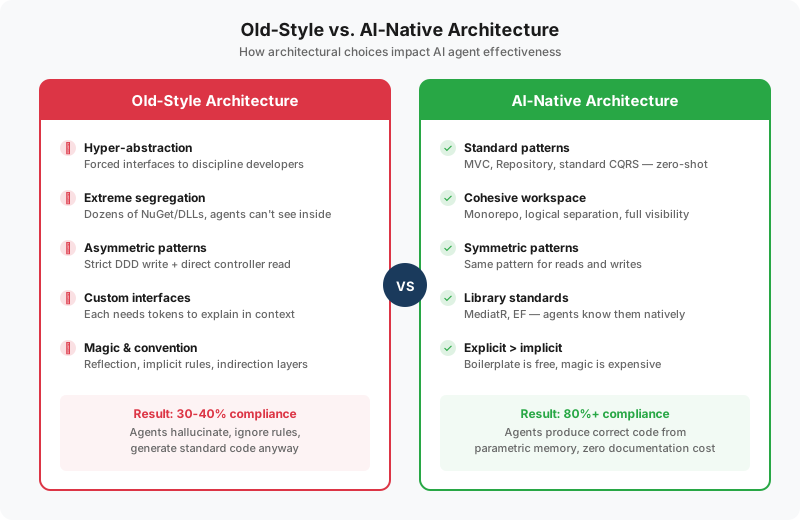
8. Architectural Comparison: Old-Style vs. AI-Native
| Dimension | Old-Style Approach | AI-Native Approach |
|---|---|---|
| Abstraction / Layering | Hyper-abstraction, forced interfaces to discipline developers | Standard market patterns, abstractions only where they add business value |
| Physical boundaries | Extreme segregation into separate DLLs/NuGet packages | Monorepo or cohesive workspace, logical separation with indexable boundaries |
| Read/Write symmetry | Strict DDD write + direct controller read | Symmetric pattern (standard CQRS or uniform layered architecture) |
| Interfaces | Custom for each entity, distributed across different assemblies | Library standards (MediatR, Entity Framework) — zero documentation tokens |
| Learning curve | The human reads the document once and learns | The AI must re-read the document every session (token cost, error risk) |
| Multi-agent resilience | Low: a “lesser” agent or one without document access will fail | High: any agent, even with a base model, can handle standard patterns |
| Documentation cost | High: exotic rules require extensive documentation | Low: standard patterns self-document through code |
| Computational verifiability | Difficult: asymmetric rules require inferential judgment | Easy: standard patterns expressible as deterministic fitness functions |
9. Operational Recommendations
For the Codebase
- Prefer patterns with high training data frequency: Repository Pattern, CQRS via standard MediatR, Layered Architecture — they are native to models and require no additional documentation
- Absolute consistency over originality: a mediocre pattern applied uniformly beats an excellent pattern applied inconsistently
- Standard interfaces over custom interfaces: widely used public NuGet packages (MediatR, FluentValidation, AutoMapper) require zero tokens to describe in context
- Architectural symmetry: if writes use a pattern, reads should use the same pattern (or an equally standard one)
For Agentic Documentation
- CLAUDE.md / AGENTS.md at the umbrella level with path-based rules for subdirectories: hierarchical structure that allows sub-agents to receive only relevant context
- Documentation budget < 500 lines for the root: beyond this threshold, instructions are systematically ignored
- Instructions as infrastructure: versioned in Git, subject to code review, shared across the team
- Prefer computationally verifiable rules (linters, ArchUnit, fitness functions) over rules that require inferential interpretation
For the Multi-Agent Lifecycle
- Configure read access to the umbrella repo even for agents operating on sub-repos
- Design for the worst case: the architecture must be understandable even by the agent with the least context in the lifecycle (the end-of-month economic model, the CI/CD agent with limited budget)
- Standard patterns = resilience: any agent, even a lower-tier one, can handle conventional patterns without additional documentation
Conclusion
Software architecture in the age of AI agents is no longer just a matter of human maintainability — it is a matter of machine legibility. Academic research, best practices from Anthropic and GitHub, and articles from industry authorities like Martin Fowler and Thoughtworks converge on the same evidence: standard patterns are not a compromise, they are a quality multiplier.
The architectural approach that favors exotic patterns, custom abstractions, and non-standard DDD/CQRS variants imposes a measurable cost: more tokens consumed for documentation, more contextual hallucinations, more inconsistency between agents with partial visibility, and accelerated quality degradation as the context window fills up.
The true role of architecture in the agentic era is to be as readable by the machine as by the human: patterns that a model instantly recognizes from training data require zero context overhead, leaving all available cognitive budget for the actual business problem.
Designing a system to defend against junior developer mistakes of 2015 — through hyper-segregation and disciplinary patterns — is an outdated approach. Designing an AI-Native system — open, predictable, standardized, and symmetric — means optimizing the codebase for the way software is actually written today and will be written tomorrow.
Complete References
| # | Source | Type |
|---|---|---|
| 1 | Liu et al., “Lost in the Middle: How Language Models Use Long Contexts”, Stanford/UC Berkeley, TACL Vol. 12, 2023 | Academic Paper |
| 2 | “Do Code LLMs Understand Design Patterns?”, arXiv, 2025 | Academic Paper |
| 3 | “LLM Hallucinations in Practical Code Generation”, arXiv, 2024 | Academic Paper |
| 4 | “Evaluating AGENTS.md: Are Repository-Level Context Files Effective?”, arXiv, 2025 | Academic Paper |
| 5 | Birgitta Böckeler, “Context Engineering for Coding Agents”, martinfowler.com, 2026 | Industry Authority |
| 6 | Birgitta Böckeler, “Harness Engineering for Coding Agent Users”, martinfowler.com, 2026 | Industry Authority |
| 7 | Rahul Garg, “Encoding Team Standards”, martinfowler.com, 2026 | Industry Authority |
| 8 | Anthropic, “Claude Code: Best Practices for Agentic Coding”, 2025 | Vendor Documentation |
| 9 | GitHub, “Using Custom Instructions for Copilot Code Review” | Vendor Documentation |
| 10 | “Monorepo vs. Polyrepo for Multi-Stack Vibe Coding”, forceweaver.com, 2025 | Industry Article |
| 11 | “Why Your AI Agent Gets Dumber with Large Specs”, lean-spec.dev, 2025 | Technical Blog |
| 12 | “Sub-Agent Context Hierarchy”, understandingdata.com, 2026 | Technical Blog |
| 13 | Microsoft, “Tackling Business Complexity with DDD and CQRS Patterns” | Official Documentation |
| 14 | “When CQRS and DDD Don’t Mix”, argosco.io, 2024 | Technical Analysis |
| 15 | “CQRS in .NET: Deep Analysis, Benefits, and Trade-Offs”, dev.to, 2026 | Technical Blog |
| 16 | Vuong Ngo, “AI Keeps Breaking Your Architectural Patterns”, dev.to, 2025 | Technical Blog |
| 17 | Ben Houston, “Agentic Coding Best Practices”, 2025 | Industry Article |
| 18 | “Preparing Your Codebase for Agentic Coding”, CHSAMI, 2026 | Technical Blog |
| 19 | “Context Windows Explained: Why Size Matters for AI Coding”, inventivehq.com, 2026 | Technical Blog |
| 20 | CodeRabbit, “GitHub Copilot Best Practices”, 2025 | Technical Blog |
Article written in April 2026. Sources and references reflect the state of the art in research and best practices at the time of publication.